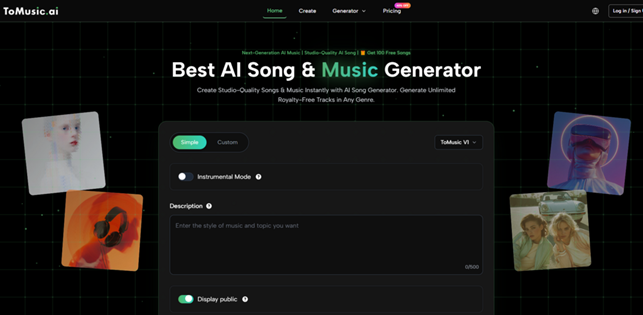
The difficulty of turning written lyrics into a complete song has traditionally required a chain of skills: composition, arrangement, recording, and production. Each step adds friction, often discouraging those who begin with words rather than sound. A system like AI Music Generator addresses that gap directly by treating lyrics not as an endpoint, but as a starting structure for full musical generation.
This approach is less about replacing musicianship and more about redefining how ideas move from text into audio. Instead of adapting lyrics to music, the system adapts music to lyrics.
Why Lyrics Function as Structural Blueprints
Embedded Rhythm and Natural Timing
Lyrics already contain:
- Syllabic patterns
- Emotional pacing
- Implicit pauses
These elements act as a scaffold for rhythm generation. In practice, lines of varying length often result in different melodic phrasing, which suggests that the system respects textual structure during generation.
Semantic Meaning Influencing Musical Tone
Words carry emotional weight. When lyrics include themes such as nostalgia or tension, the generated music tends to reflect those moods through:
- Minor or major tonal shifts
- Instrument selection
- Tempo variation
This connection appears consistent enough to influence the overall feel of the track.
Mechanism Behind Lyrics-to-Audio Conversion
Stepwise Interpretation of Textual Input
The process seems to involve:
- Breaking lyrics into segments
- Mapping segments to rhythmic units
- Assigning melodic contours
- Building harmonic support
This layered interpretation allows the system to maintain coherence across longer compositions.
Alignment Between Voice and Instrumentation
One notable aspect is how vocal lines align with backing tracks. In many cases:
- Vocal timing feels synchronized with instrumental rhythm
- Dynamic changes correspond with lyrical emphasis
This indicates integrated generation rather than separate processing.
Actual Workflow Based on Platform Behavior
Step 1: Input Lyrics or Combined Prompt
Users can provide:
- Full song lyrics
- Partial verses with descriptive context
The system does not require strict formatting, though structured lyrics often yield clearer results.
Step 2: Choose Style and Generation Mode
Users can influence output by specifying:
- Genre
- Mood
- Vocal characteristics
Custom settings provide more predictable outcomes than fully automated Text to Music generation.
Step 3: Generate Song and Evaluate Result
The output includes:
- Instrumental arrangement
- Vocal interpretation
- Complete track structure
Regeneration is often necessary to refine alignment between lyrics and melody.
Comparing Lyrics-Based Creation With Other Methods
|
Aspect |
Lyrics-Based Generation |
Instrumental Prompting |
|
Input complexity |
Medium |
Low |
|
Structural clarity |
High |
Medium |
|
Emotional alignment |
Strong |
Variable |
|
Control over phrasing |
Moderate |
Low |
|
Predictability |
Moderate |
Lower |
Lyrics introduce constraints that guide the system, which can improve coherence but reduce randomness.
Practical Use Cases Emerging From This Approach

Songwriting Without Production Skills
Writers can move directly from text to song, bypassing traditional composition steps.
Concept Testing for Musical Ideas
Lyrics can be quickly transformed into multiple musical interpretations, enabling comparison between styles.
Content Creation and Narrative Audio
Narrative-driven videos or projects benefit from music that aligns closely with written scripts.
Limitations Observed During Use
Sensitivity to Wording and Structure
Small changes in phrasing can significantly alter Lyrics to Music AI output. This suggests that the system heavily relies on linguistic cues.
Occasional Mismatch Between Lyrics and Melody
In some cases, syllable alignment may feel slightly off, particularly with complex or irregular phrasing.
Limited Fine-Grained Editing
Users cannot easily adjust specific notes or timing after generation.
The Broader Implication of Lyrics-Driven Composition
What stands out is how the creative process shifts:
- From composing music first → to writing meaning first
- From arranging sound → to shaping narrative
This inversion changes how creators think about music entirely. Instead of building a track and fitting lyrics into it, the system builds the track around the lyrics themselves.
Future Direction of This Workflow
As models improve, several developments seem likely:
- Better syllable-to-note alignment
- More nuanced emotional interpretation
- Greater consistency across regenerations
The direction is clear: reducing the gap between written expression and musical realization.
In that sense, the system is not simply generating songs. It is redefining how songs begin.